ECU, UHS summit aims to improve quality of life in eastern N.C.

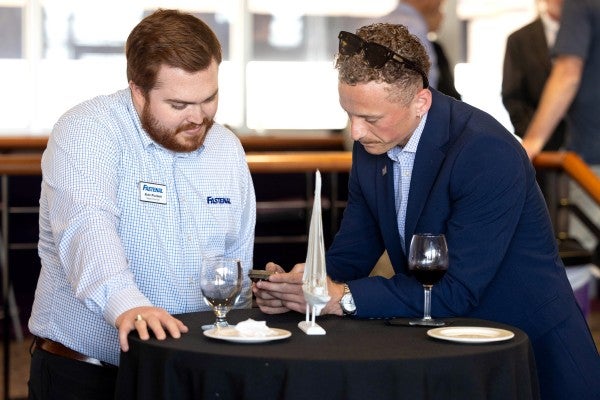
From left, UHS Chief Executive Dave McRae, Dr. Bill Roper of UNC-Chapel Hill and Bill Shelton, ECU interim chancellor, discuss ways to improve life in eastern North Carolina during a health and economic development summit held Dec. 4-5 in Atlantic Beach.
GREENVILLE, N.C.
(Dec. 17, 2003)
—
Hoping to do more to support economic development
in eastern North Carolina, health system and university
leaders caucused with regional boosters of every stripe at a
"quality-of-life summit" Dec. 4 and 5.
The meeting, consisting of two half-day sessions held at
Atlantic Beach, was originally intended to be an educational
retreat for the board of University Health Systems
of Eastern Carolina. But a growing recognition of the
three-way link among the East's deteriorating economic
condition, health care and education provoked a broader,
bolder approach. East
Carolina University joined
as co-sponsor, and the
retreat mushroomed into
what amounted to a 24-
hour brainstorming session.
"It has become clear that
we're not going to improve
the health status of the
region merely by building a
bigger hospital in
Greenville," said Dave
McRae, UHS's chief
executive officer. "None of
us is going to solve these
problems working in
isolation. It's going to take
collaboration across the
region and the commitment
of the people who live and
work here."
The keynote speaker for
the event was Dr. William
Roper, dean of the School of
Public Heath at the
University of North
Carolina at Chapel Hill.
Roper, a physician who has
headed the Centers for
Disease Control and
Prevention and Medicare,
discussed three interrelated problems that plague health
care in the United States - high cost, poor quality and
lack of access. The system is headed toward crisis with
each of these challenges, he said.
The problems are largely self-inflicted, though. Roper
and others noted, for example, that medical errors and
unnecessary medical procedures add considerably to the
nation's health care costs. Moreover, roughly half of all
premature deaths in the U.S. population result from
unhealthy behaviors such as smoking, poor diet and lack
of exercise.
Roper singled out the obesity epidemic as the best
recent example of a preventable tragedy. Although reform
measures can be taken like working with the food industry
to limit sugar and fat content in their products and
encouraging schools to promote exercise, ultimately
people have to decide they don't want to be fat.
"We made dramatic progress on smoking in America
when it became unfashionable to smoke," said Roper. "We
need to understand better than we do how these kind of
mindshifts in the population happen."
For the remainder of the summit, in general sessions,
small group discussions and one-on-one hallway conversations,
doctors, educators, health administrators, public
health officials, business leaders and politicians shared
their perspectives on what it will take to improve the
quality of life in the region. There was a thorough airing
of the problems but - most seemed to agree - no
abundance of answers beyond the need to work together
and to favor action over talk.
"I wish I had a magic wand to make it all better, but
there's only one way to make it better and that's by
chipping away at it every day," said Roper. "You've got to
be in the community, the schools, the church and the
media."
Lawrence Davenport, a Pitt County farmer and the
former chairman of the UHS board of directors, said he
has long felt that ECU and University Health Systems
should be more involved in "grassroots economic development."
Davenport currently serves as the chairman of
the Golden Leaf Foundation, a $2 billion trust fund established
with part of the proceeds from the national tobacco
settlement. The foundation has a charge to secure the
future of rural North Carolina through investments in
development
activities.
Davenport
said the decline
of the tobacco
economy, the
disappearance of
textile jobs and
the body blows
delivered by two
hurricanes have
produced "a lost
generation" in
the region.
"Other parts
of the state are
moving ahead,"